
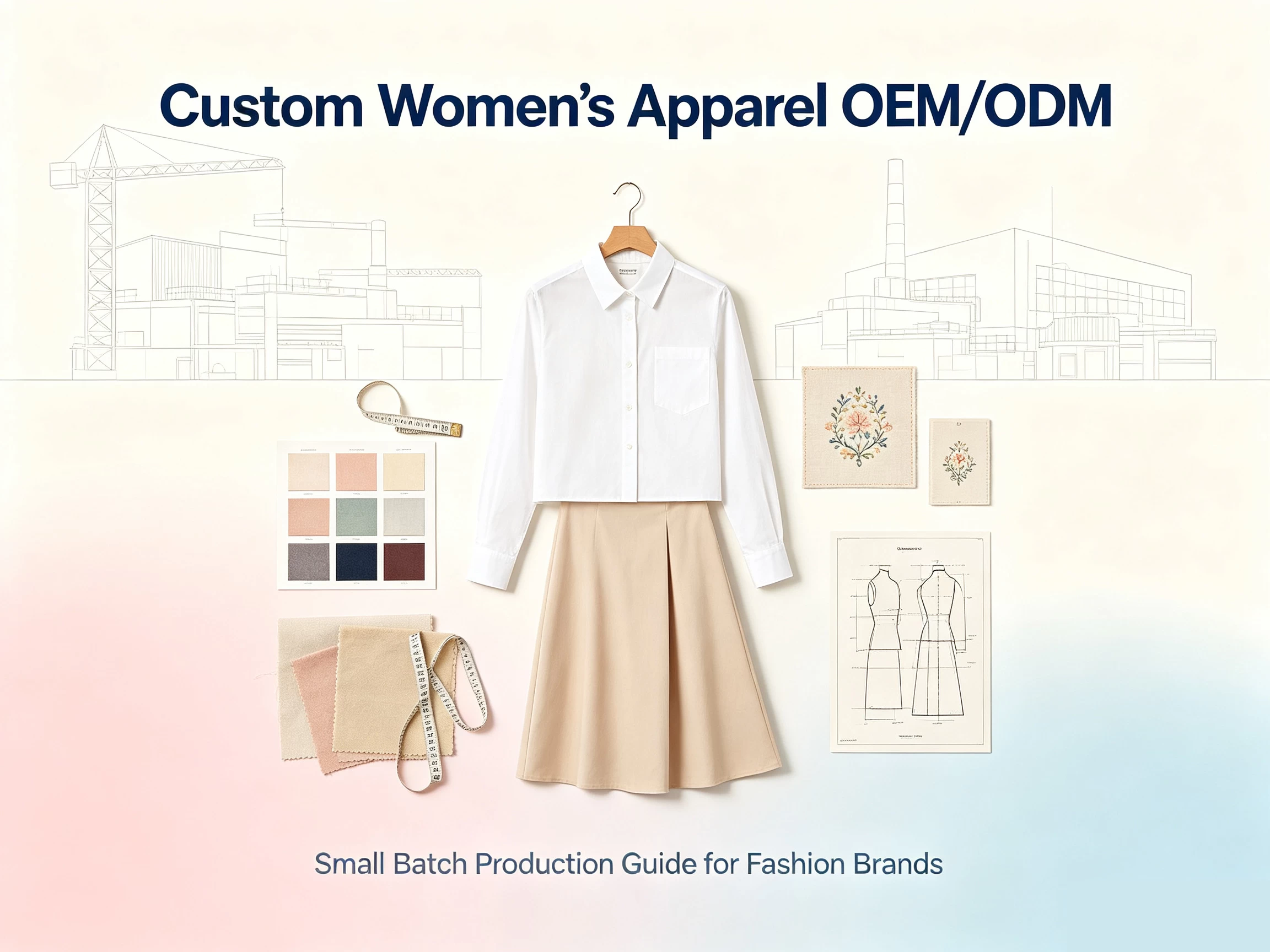
For emerging fashion brands, cross-border e-commerce sellers, and private label retailers, launching a women’s clothing line often comes down to one critical decision: finding a reliable OEM/ODM manufacturer that can support small batch orders, consistent quality, and on-time delivery.
Many new brands face a common dilemma: you want to minimize inventory risk and test the market with small orders, but you worry that low-volume production will mean compromised quality, delayed lead times, or limited customization options.
In this guide, we break down everything you need to know about custom women’s apparel manufacturing—from the differences between production models to the non-negotiable criteria for selecting a factory partner—so you can build a supply chain that grows with your brand.
Understanding OEM, ODM, and Private Label: Which Model Fits Your Brand?
Understanding OEM, ODM, and Private Label: Which Model Fits Your Brand?
Before you reach out to manufacturers, it’s important to clarify which production model matches your brand stage and design capabilities:
- OEM (Original Equipment Manufacturing)You provide full design specifications, tech packs, fabric standards, and branding requirements. The factory produces garments exactly to your brief and applies your labels. This model is ideal for established brands with in-house design teams.
- ODM (Original Design Manufacturing)The factory offers a library of pre-developed styles, patterns, and silhouettes. You can select base designs, customize fabrics, colors, details, and add your own branding. This is perfect for brands that want to launch quickly without building a design team from scratch.
- Private Label ServiceThe most accessible entry option: you choose from ready-made styles, add your custom labels, tags, and packaging. It’s the fastest way to test product-market fit with minimal upfront investment.
At Maodi Apparel, we support all three models. Even if you only have a rough concept for your line, our in-house team can provide style references and technical suggestions to turn your idea into a finished product.
5 Key Factors to Evaluate a Women’s Apparel Manufacturing Partner
5 Key Factors to Evaluate a Women’s Apparel Manufacturing Partner
Not all factories are created equal. To avoid costly missteps, focus on these 5 hard indicators when vetting potential partners:
1. Deep, specialized experience in women’s apparel categories
Women’s fashion spans diverse product categories—from flowy maxi dresses and tailored blouses to knit loungewear and structured outerwear—each with unique pattern-making and sewing requirements. A factory that specializes in women’s wear will have more mature grading, fit, and craftsmanship.
With 17 years of focused experience in women’s garment manufacturing, Maodi Apparel has developed over 1,000 styles across dresses, tops, t-shirts, tank tops, pants, coats, and loungewear. Our deep category expertise means we understand fit nuances and can execute your designs with precision.
2. Flexible low MOQ customization
For startup brands, large minimum order quantities are one of the biggest barriers to entry. A manufacturer that supports low MOQ (minimum order quantity) lets you test new styles, experiment with trends, and manage cash flow without overstocking.
We prioritize flexible production for growing brands. Our low MOQ policy allows you to place small trial orders, so you can validate market demand before scaling up to larger production runs.
3. Full craft capabilities + verified quality control systems
Print durability, embroidery neatness, consistent sizing, and clean stitching are the details that define your brand’s reputation.
When evaluating a factory, check two things:
- Craft range: Can they deliver the techniques your designs need—screen printing, heat transfer, metallic print, puff print, embroidery, and more?
- Quality certifications: Do they hold internationally recognized standards that prove consistent quality?
Maodi Apparel offers a full suite of customization techniques, and our production system is certified to BSCI, OEKO-TEX Standard 100, and Intertek standards. We enforce 8-step quality control throughout production—from fabric inspection and laying up, to cutting, sewing, ironing, final inspection, and packaging—to ensure every batch meets your specifications.
4. Proven production capacity & reliable delivery
Lead time delays can derail launch schedules, hurt store rankings, and disappoint customers—especially during peak seasons.
To assess delivery reliability, look at factory scale:
- 8,000㎡ production floor
- 200+ skilled workers
- 1,000,000+ pieces monthly output capacity
- 2,000㎡ ready-to-ship warehouse
At Maodi Apparel, our scaled operations and mature supply chain allow us to handle both small trial orders and large bulk orders with stable lead times, even during high-demand seasons.
5. End-to-end one-stop service
Custom apparel production involves many moving parts. Working with a factory that manages the full process in-house reduces communication friction, saves you time, and lowers the risk of errors between stages.
Our one-stop service covers every step: design consultation, fabric sourcing, sampling, mass production, quality control, and custom packaging. You’ll have a dedicated account manager to update you on progress at every stage, so you can focus on building your brand instead of chasing suppliers.
The Full Custom Apparel Process: From Idea to Delivered Goods
The Full Custom Apparel Process: From Idea to Delivered Goods
If you’re new to custom manufacturing, the standard workflow at a professional factory follows these clear steps:
- Requirement ConsultationShare your style ideas, fabric preferences, craft requirements, order quantity, and target delivery date. We’ll review your brief and provide initial feedback.
- Solution ConfirmationIf you have existing design files (PDF/PSD/CDR), we’ll assess feasibility and provide a quote. If you’re starting from scratch, we’ll recommend styles, fabrics, and details based on your brand positioning.
- SamplingWe produce a pre-production sample for your approval, including the exact fabric, construction, and branding details.
- Sample Approval & RevisionReview the sample and request any adjustments to fit, details, or materials. We’ll revise until you’re fully satisfied.
- Mass ProductionOnce the sample is approved, we schedule production and manufacture the full order strictly to the approved sample standard.
- Final Inspection & Custom PackagingOur QC team conducts a full inspection of the finished goods. We then apply your custom labels, tags, and packaging as requested.
- Shipping & DeliveryWe arrange logistics and ship your order to your specified destination, with full tracking support.
Pro Tips for New Fashion Brands- Start with sampling firstAlways approve a physical sample before placing a bulk order. This is the best way to verify quality, fit, and craftsmanship upfront.
- Plan ahead for peak seasonsBuild extra time into your production schedule for spring/summer and holiday peak periods. Early planning avoids rush fees and delivery delays.
- Start with ODM if you’re new to designIf you don’t have a design team, start with our ready-to-develop ODM styles. Customize colors, fabrics, and branding to launch your line quickly and cost-effectively.
- Prioritize long-term partnership over lowest priceA reliable manufacturing partner that understands your brand will deliver more consistent quality, better communication, and greater flexibility over time. Stability in your supply chain is more valuable than short-term cost savings.
Grow Your Brand with a Trusted Women’s Apparel Manufacturer
With 17 years of OEM/ODM experience, low MOQ customization, and full end-to-end service, Maodi Apparel is the ideal manufacturing partner for women’s fashion brands of all sizes.Ready to bring your designs to life? Contact us today to request our free style catalog and get a custom quote for your next collection.
