
Quick answer
Between the cutting table and the final carton, a women's top passes through seven craft stages that decide whether it looks like the sample: cutting, sewing the main body, the neckline and armhole finish, decoration (print or embroidery), trim and label attachment, pressing and finishing, and inspection and packing. The stages that most often differ between a good garment and a disappointing one are the third and the sixth — the neckline finish and the pressing — because both are labour-intensive, both are hard to correct afterwards, and both are where a factory under time pressure will cut the least visible corner.
A women's top is a small object made of a small number of operations, and the difference between a garment that sells the brand and one that generates a complaint is rarely the design. It is the discipline applied at a handful of steps that no customer will ever see being performed.
This article describes the craft sequence we run at Guangzhou Maodi Clothing Co., Ltd., where women's tops, camisoles, tank tops, sleeveless tops and knitwear are produced at a monthly capacity of up to 1,000,000 pieces across a 12,000 m² facility and a team of more than 280 production staff. It is written for buyers and product developers who want to know what to look at, and what to ask, when they assess a garment or a factory.
1. Cutting: where the batch is won or lost
Cutting is the first irreversible step. Once the blade has moved, the fabric is committed, and defects introduced here travel all the way to the finished carton.
- Fabric relaxation before cutting. Knitted and elastic fabrics need time to relax after roll-off before they are laid. Cutting fabric that is still under tension produces panels that grow or skew after washing — a defect that only appears after the customer has worn the garment.
- Ply control on laid-up fabric. The more plies in a lay, the more the bottom plies can shift, and the more a stripe or a check drifts. On striped and plaid fabrics the lay height should be reduced rather than pushed for speed.
- Shade banding within a lay. Fabric from different dye lots can be very slightly different in shade. Even within one lot, panels cut from the beginning and the end of a roll can differ enough to show on a finished garment. Tracking which panels came from which roll is what prevents a two-tone top.
- Notches and panel matching. The notches that align a side seam or a stripe are only useful if they were cut accurately. A notch cut off-position produces a garment with a twisted side seam that cannot be corrected during sewing.
2. Sewing the main body: seam type, thread and stitch density
Seam selection is a functional choice as much as a cosmetic one, and it should follow the fabric and the garment's stretch.
| Seam type | Best suited to | What it costs | Where it fails |
|---|---|---|---|
| Overlock (serged) | Knit tops, seams that will not be seen | Fast, economical | Cannot stretch with the fabric unless it uses the right stitch and thread |
| Flatlock | Activewear and fitted knits; flat seam, no bulk | Slower, machine-intensive | Needs careful tension; can pucker on light fabric |
| Coverstitch | Hems and neckline binding on knits | Slower than overlock | Produces a wavy hem if feed and stretch are mismatched |
| Lockstitch | Woven tops: shirts, blouses, structural seams | Strong and precise | No stretch; unsuitable for knit garments that need to move |
| French seam | Sheer and lightweight wovens where the inside is visible | Two operations, higher labour | Adds bulk at tight corners |
Two details matter more than the choice of seam. The first is thread: a knit garment sewn with a thread that has less stretch than the fabric will break at the seam the first time the garment is pulled on, however well the stitch itself is set. The second is stitch density. Too few stitches per inch and the seam gapes; too many and the fabric perforates, particularly on fine knits. Stitch density should be specified per fabric, not applied as a factory default.
3. Neckline and armhole: the step that decides how the garment reads
If one operation determines whether a top looks expensive, it is the neckline. It is the first thing a customer sees, it is the hardest area to correct after the fact, and it is where a small dimensional error becomes a visible wavy or gaping edge.
Three finishing methods cover most women's tops:
| Method | Appearance | Best for | Risk |
|---|---|---|---|
| Self-fabric binding | Clean, matched edge; can be narrow or wide | Camisoles, tank tops, vests | Binding cut on the wrong grain will not lie flat |
| Ribbed banding | Structured, holds shape well | Tops and T-shirts where the neckline must keep its shape | Band ratio must be calculated; a guessed ratio gives a wavy edge |
| Facing and turn | Invisible from outside | Wovens: shirts and blouses | Facing can roll out if not secured or caught down |
The recurring failure in the first two rows is a ratio problem rather than a sewing problem. A ribbed neckband must be cut to a calculated percentage of the neckline length — commonly in the region of 75 to 85 per cent depending on the rib's stretch — and the ratio depends on the specific fabric. A band cut to the wrong ratio will produce a wavy neckline no matter how skilled the operator, and the error is not correctable by pressing or by re-sewing. For this reason the band ratio belongs in the specification, computed from the actual fabric, and should be verified on a test run before the batch is sewn.
The armhole deserves the same attention, and it is where fit and craft meet. An armhole that is too deep restricts movement; one that is too shallow binds. Binding or banding an armhole on a sleeveless top adds a further constraint, because the finish must follow a curve while still allowing the edge to stretch with the fabric rather than resisting it.
4. Decoration: print and embroidery as manufacturing steps
Decoration is frequently discussed as a design choice and it is equally a production step with its own tolerances and failure modes.
| Technique | Effect | Substrate requirement | Typical failure |
|---|---|---|---|
| Screen printing | Flat, opaque, economical in volume | A surface that holds ink without flooding | Ink bleeding on loose or highly textured knits |
| Heat transfer | Fine detail, photographic gradients | Fibre that tolerates press temperature | Scorching or glazing on heat-sensitive synthetics |
| Metallic print | Reflective, decorative finish | Stable substrate; the metallic layer is not elastic | Cracking when the garment stretches |
| Puff print | Raised, dimensional surface | Substrate stable enough to carry a raised layer | Distortion during curing; uneven height |
| Embroidery | Durable, premium, textured | Fabric that supports stitch density without puckering | Puckering on light or highly elastic knits |
The right-hand column is the reason decoration cannot be decided after the fabric. A metallic print on a four-way stretch knit will crack the first time the garment is pulled on, because the metallic layer does not stretch with the fabric. Embroidery on a very light jersey will pucker, because the stitch density required for a legible mark exceeds what the fabric can support. These are not quality failures in the sense of something being done badly — they are mismatches, and they are predictable in advance.
Placement carries its own tolerance. A print that sits 5 mm off-centre on the chest is more noticeable than a 5 mm measurement deviation at a side seam, because the customer's eye reads symmetry instantly. Placement should therefore be specified with a tolerance and checked against a placement template rather than by eye at the machine.
5. Trim, label and the details a customer touches
Trims are low-cost components with a disproportionate effect on perceived quality, and they are also the most common source of delivery delay because they are ordered separately from fabric.
- Labels and tags should be confirmed and ordered alongside the fabric, not after. A programme that is fabric-ready and label-blocked is a programme that cannot ship.
- Care and content labels must state composition and care accurately for the market the garment is destined for; requirements differ between regions.
- Adjusters, sliders and elastics on camisoles and strappy tops are functional components and should be tested for hold and finish, not only approved as a sample.
- Label placement and stitch affects comfort. A care label sewn into a side seam with an overlock that catches the wearer's skin is a complaint waiting to happen on a light garment.
6. Pressing and finishing: the invisible step with the biggest effect
Pressing is where a garment gains or loses its perceived value, and it is the step most often compressed when a schedule is tight. Done properly, it removes the construction marks, sets the seams and gives the garment its intended shape. Done quickly, it leaves shine marks on the fabric, a flattened hand feel on a raised-surface knit, and hems that are not flat.
| Task | Why it matters | Common shortcut |
|---|---|---|
| Seam setting before final press | Locks the seam so it holds its line after washing | Skipped; the seam then opens in wear |
| Temperature matched to fibre | Prevents shine and glazing on synthetics and wool blends | One setting used across all fabrics |
| Pressing on the reverse or through a cloth | Protects surface texture and decoration | Direct pressing over print and puff detail |
| Trimming and thread cleaning | Removes loose threads that read as poor finishing | Partial cleaning; threads found by the customer |
The last row is worth emphasising because it is the cheapest step to do properly and the most visible when it is not. A garment of excellent construction with visible loose threads will be judged as a poorly made garment — the customer has no way to separate the two judgements.
7. Inspection and packing: what a final check should actually cover
Inspection on finished goods is the last defence, not the first. Its purpose is to catch what the earlier stages missed and to prevent a defective unit from reaching a carton.
| Check | What is verified | Consequence if skipped |
|---|---|---|
| Measurement | Key dimensions against the sealed sample chart | A batch that is consistent and consistently wrong |
| Construction | Seam integrity, neckline flatness, hem evenness | Failures that appear in the first wash |
| Decoration | Placement, registration, adhesion, no cracking | Visible asymmetry the customer notices immediately |
| Appearance | No oil marks, no shine, no pulled threads, no shade variation | Cosmetic defects that trigger returns |
| Trims and labels | Correct label, correct placement, secure attachment | Market compliance failure at the border |
| Packing | Folding, polybag, size and colour marking, carton configuration | Picking errors and damaged goods in transit |
Packing configuration is worth agreeing early rather than at the last minute, because it determines how the goods are counted, marked and staged. For a retail programme, marking cartons by style, colour and size turns distribution at the other end from a sorting task into a delivery task. For an e-commerce programme, individual polybagging and barcode labelling may be required, and both change the labour content significantly.
8. What to look at when you assess a women's top
If you have a garment in your hand and a few minutes to judge its craft, these seven checks will tell you most of what you need to know.
| # | Check | What a good result looks like |
|---|---|---|
| 1 | Lay the neckline flat on a table | Sits flat with no wave; band width even all the way round |
| 2 | Stretch the neckline gently and release | Recovers to its original shape; band does not stay stretched |
| 3 | Look at the shoulder seams from both sides | Even, no puckering, no misaligned stripe or pattern |
| 4 | Hold the hem against a light | Even depth, no twisting, cover stitch consistent |
| 5 | Inspect the inside of the side seam | Clean overlock, no loose threads, care label lies flat |
| 6 | Stretch a decorated area | Print moves with the fabric without cracking or lifting |
| 7 | Check symmetry of any chest placement | Visually centred; no rotation |
The second check is the one most revealing, and the one most buyers skip. A neckline that does not recover after being gently stretched will lose its shape in wear, and no amount of pressing at the factory changes that — it is a band ratio or a thread problem, decided long before the garment reached the finishing table.
Frequently asked questions
Why does a neckline go wavy after a few wears?
Usually because the neckband was cut to the wrong ratio for the fabric, or because the sewing thread has less stretch than the garment. A ribbed neckband has to be cut to a calculated percentage of the neckline length — commonly somewhere in the region of 75 to 85 per cent, depending on how much the specific rib stretches — and a band cut to a guessed ratio will produce a wavy edge regardless of how well it is sewn. The second cause is thread: sewing a stretch knit with a low-stretch thread means the band cannot recover, so it stays stretched. Both are specification errors rather than sewing errors, which is why they belong in the tech pack.
Can print or embroidery damage a light knit garment?
Not damage, but a mismatch — and a predictable one. Metallic prints do not stretch with the fabric, so on a four-way stretch knit the metallic layer cracks the first time the garment is pulled on. Embroidery needs the fabric to support a certain stitch density; on a very light jersey that density puckers the surface around the mark. Heat transfer needs the fibre to tolerate press temperature, or the surface scorches or glazes. The common thread is that decoration has to be chosen against the fabric rather than applied to it afterwards, and the time to establish compatibility is before the sample is made.
What is the most common cosmetic defect in women's tops?
In our experience it is visible loose threads and incomplete trimming, followed by shine marks from pressing. Both are trivially cheap to prevent and highly visible to the customer. A purchaser has no way to separate "excellent construction with visible threads" from "poorly made" — the judgement is made in one glance. Shine marks come from pressing a synthetic or wool-blend fabric at a temperature set for cotton, or pressing directly over the garment face instead of on the reverse or through a cloth. Both defects are caught at final appearance inspection if the inspection is genuinely done rather than sampled.
Why does fabric need to rest before cutting?
Knitted and elastic fabrics hold tension from the roll and from the knitting process. If they are laid and cut while still under that tension, the panels relax afterwards and grow or skew — so a garment that measured correctly at the cutting table measures differently after washing. Resting the fabric before cutting costs time and floor space rather than money, and it is one of the clearest markers of a factory that understands garment behaviour rather than just throughput. Skewed panels cannot be corrected during sewing, so the cost of skipping this step is a batch of distorted garments.
How do I check a garment if I only have a few minutes?
Seven checks tell you most of what you need. Lay the neckline flat and look for a wave. Stretch it gently and see whether it recovers. Inspect the shoulder seams from both sides for puckering or misaligned pattern. Hold the hem against a light for even depth and no twist. Look inside a side seam for clean overlocking and a flat care label. Stretch a printed area to see whether the print moves with the fabric or cracks. And check that any chest placement is visually centred and not rotated. The gentle neckline stretch is the most revealing of the seven, because a band that does not recover will lose its shape in wear and cannot be fixed by pressing.
Can you customise construction details as well as fabric and colour?
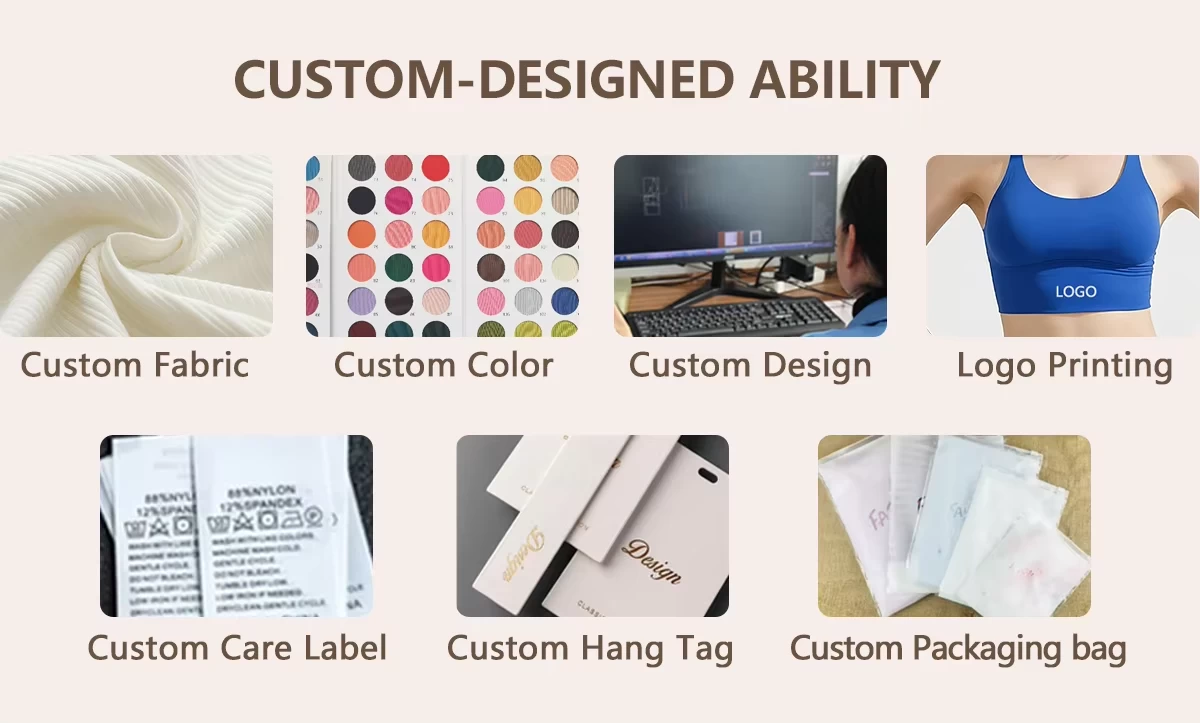
Yes. Beyond fabric, colour and decoration, we work with customers on construction details including neckline finish method, seam type, hem treatment, label and tag specification, and packing configuration. The practical requirement is that each of these is written into the specification and the sealed sample, because that is what the bulk batch will be measured against. A construction detail that lives only in a conversation cannot be inspected, and an uninspectable requirement is the most common reason a shipment that is genuinely well made still gets rejected.
Send a garment or a reference and we will return a construction review
Guangzhou Maodi Clothing Co., Ltd. manufactures women's apparel — camisoles, tank tops, sleeveless tops, built-in bra tops and knitted garments — across a 12,000 m² factory with more than 280 production staff and a monthly output capacity of up to 1,000,000 pieces, backed by 17 years of apparel manufacturing experience and a 2,000 m² ready-to-ship warehouse. Our process covers design development, fabric selection, sample making, mass production and final inspection, with construction details customised to your specification rather than applied from a house default. Send a reference garment, a tech pack or a sample you are unhappy with, and our team will return a construction review covering neckline and armhole finish, seam and thread selection, decoration compatibility, and trim and packing specification.
